



American Airlines is considering a major widebody order and is weighing its liquidity options amid rising fuel costs, executives explained during the J.P. Morgan Industrials Conference on Tuesday.
Rising fuel costs from the Iran conflict have been a major focal point for airlines so far this month. Chief Financial Officer Devon May explained that the carrier would consider extra liquidity if current fuel prices are sustained.
“If elevated fuel continues, then perhaps we’ll go to the market to raise some incremental liquidity, but we’re in a great spot now,” May said. “We have an impact in the first quarter, and there’ll be some level of impact in the second quarter, but we’re going to give it some time before we change anything.”
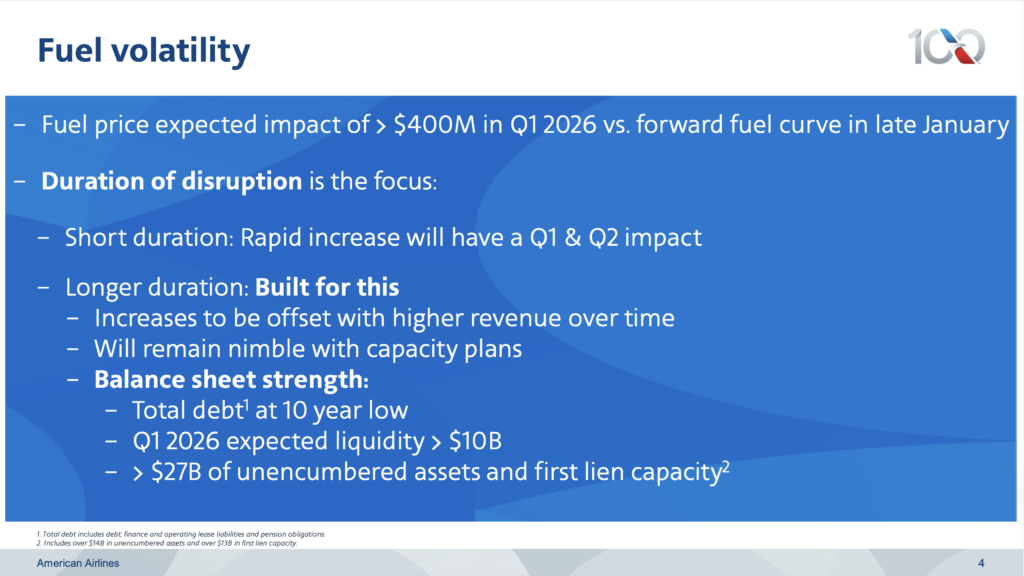
American has seen an approximately $400 million increase in fuel costs this month.
At its peak, American Airlines had more than $50 billion in debt, but it has worked down to about $36 billion today, with about $10 billion in liquidity.
If and when the airline looks to borrow, the company has assets like its loyalty program and its fleet for a stronger balance sheet.
Despite uncertain times in the industry, the airline is confident about consumer demand, particularly regarding a resilient premium market.
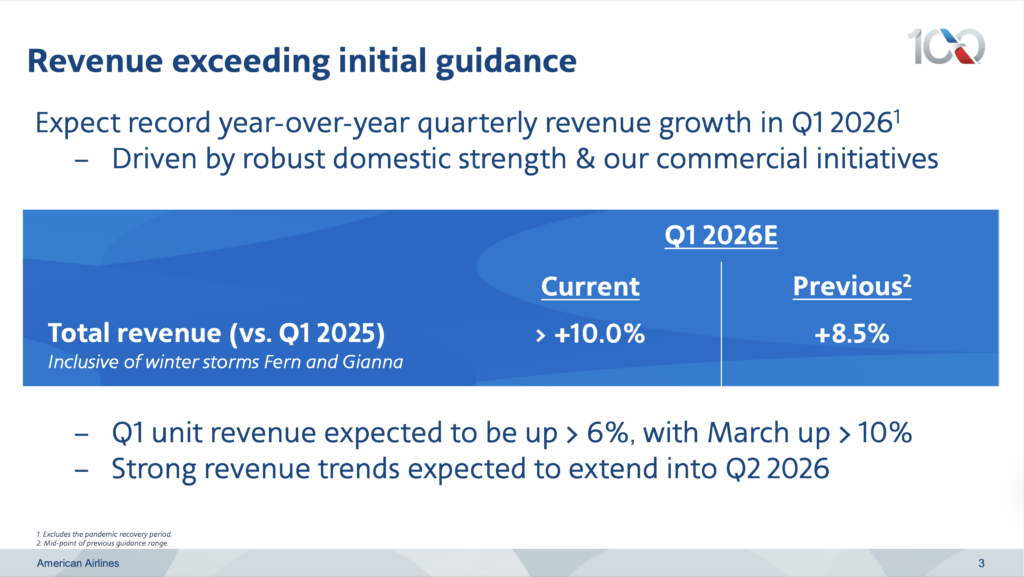
American is forecasting its first-quarter revenue to grow “more than” 10% year over year, up from previous guidance of 7% to 10%, expecting it to be the highest year-over-year growth in its history.
“The revenue growth for American in the first quarter is incredibly strong, and we see that progressing as we move throughout the year,” said American Airlines CEO Robert Isom. “There continues to be very, very strong demand for our premium products, and we’re seeing main cabin strength as well.”
This is a similar trend seen by other U.S. airlines. Delta Air Lines forecasts its first-quarter revenue growth in the high single digits, with CEO Ed Bastian explaining that it sees strength across main, premium, and loyalty revenue.
American has fallen behind United and Delta in premium and international capacity over the past decade, and consequently has struggled to produce financial results. This is evident in the airline’s overall premium capacity going down, particularly in the long-haul market. This largely stems from the carrier’s decision to sacrifice the front cabin with the introduction of premium economy, in addition to prematurely retiring mid and long-haul aircraft during the pandemic to simplify its fleet.
An analysis by Brett Snyder of Cranky Flier shows that the percentage of American’s business class seats went down from 13.5% to 13.2% over the past decade.
Over the past year, the airline has introduced free Wi-Fi and new aircraft configurations with higher premium capacity, and the airline expects to grow its long-haul premium capacity by 50% by the end of the decade.
CEO Robert Isom laid out its ambitions and explained that the airline “has the fleet to do exactly that.” The airline will particularly make a strong focus on four hubs in 2026: Philadelphia (PHL) as another transatlantic gateway, Chicago O’Hare (ORD) as its third major hub, Miami (MIA) as its Latin America gateway, and Phoenix (PHX) as the leading carrier in the city.
In order to continue to grow and close the gap between it and its rival carriers, however, American will need more aircraft. And it is doing just that, considering a major widebody order, according to a Bloomberg report.
May explained that the airline is in the market for a major widebody order, considering options from both Boeing and Airbus.
“It’s just a matter of time,” May said. “We’ll probably put an order in in the not-too-distant future on the widebody side, but when you look at this decade, the fleet is in fantastic shape.”
In addition to adding more aircraft, the airline is in the process of refurbishing its Boeing 777-300ER fleet with Project Olympus. The new interiors will add 18 business class seats, in addition to Wi-Fi powered by Viasat.
The airline also has plans to refurbish its Boeing 777-200 aircraft similarly, although the exact timeline remains unclear at this point.
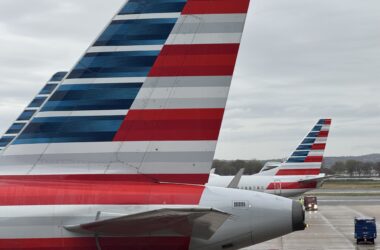
Featured image by the author.
Very good i like it